Same kilowatt-hour, very different price
On a typical weekday in the Netherlands or Belgium, the wholesale electricity price at 3am might be €0.04 per kWh. At 6pm that same day — when everyone comes home and starts cooking — the same kilowatt-hour can cost €0.38. That's nearly a 10x difference.
If you have a dynamic energy contract (via Tibber, Frank Energie, Vandebron, or similar providers), you pay the actual market price every hour. Most households barely notice this because their consumption patterns haven't changed. EV owners, however, have a significant opportunity: a 60 kWh battery charged at the cheapest hours versus the most expensive hours is a difference of roughly €20 per full charge.
Where Do Dynamic Prices Come From?
European electricity prices are set on two primary exchanges: EPEX Spot (for Belgium, Netherlands, France, Germany) and Nordpool (for Scandinavia). Every day, energy producers and suppliers bid for the next day's hourly slots in what's called the 'day-ahead auction'. The clearing price of each hour becomes the spot price.
Your dynamic supplier passes this price to you, usually with a fixed markup to cover their costs. The day-ahead prices for tomorrow are published each day at around 1pm — which is why smart charging apps can plan your overnight session hours in advance.
When Is Electricity Cheapest? The Typical Pattern
While prices vary daily depending on wind, solar output, and demand, a reliable pattern holds across most of the year:
| Time Window | Typical Price Level | Reason |
|---|---|---|
| 00:00 – 06:00 | Very low (€0.03 – €0.10/kWh) | Demand minimal, wind often strong at night |
| 06:00 – 09:00 | Rising (€0.10 – €0.25/kWh) | Morning peak: showers, heating, commute |
| 10:00 – 14:00 | Low–moderate (€0.05 – €0.15/kWh) | Solar production peaks, demand moderate |
| 15:00 – 20:00 | High (€0.20 – €0.45/kWh) | Evening peak: cooking, heating, EV charging |
| 20:00 – 23:00 | Moderate and falling (€0.10 – €0.20/kWh) | Demand gradually drops after dinner |
The practical takeaway: night charging (12am–6am) and midday charging (solar peak hours) are almost always cheapest. The evening window between 5pm and 8pm is almost always the most expensive time to charge.
How Much Can You Actually Save?
Let's run the numbers for a typical EV owner in the Netherlands driving 15,000 km per year — roughly 3,000 kWh of charging annually.
| Charging Strategy | Average Price Paid | Annual Charging Cost |
|---|---|---|
| Random / whenever convenient | €0.28/kWh (daytime average) | €840/year |
| Evening charging (5–8pm) | €0.35/kWh (peak hours) | €1,050/year |
| Night charging (12am–6am) | €0.08/kWh (off-peak) | €240/year |
| Smart scheduling (best hours daily) | €0.06/kWh (optimised) | €180/year |
The difference between habitual evening charging and optimised smart scheduling is over €800 per year — for the same kilometres driven, the same car, the same charger.
The Complication: It's Not the Same Every Day
The pattern above is typical, but not guaranteed. On a very windy day, prices can go negative — the grid is flooded with cheap wind power and suppliers actually pay you to consume. On a cold, still winter day with no solar, prices can spike to €0.60/kWh or higher even in the middle of the afternoon.
This is where manual scheduling breaks down. Setting 'always charge at 2am' captures most of the savings most of the time — but it misses the days when noon is actually cheapest, or when you should charge quickly before tomorrow's price spike.
A smart energy management system checks actual day-ahead prices every day and rebuilds your charging schedule around tomorrow's specific price curve — not a generic pattern.
Solar + Dynamic Pricing: The Optimal Combination
If you have solar panels, the calculus gets more interesting. During the hours your panels produce more than you consume, that surplus is either exported (usually at a very low compensation rate) or used to charge your EV at zero marginal cost.
The optimal strategy combines both signals: charge from solar surplus during production hours, then fill the remaining battery capacity during the cheapest overnight window. Done well, this can bring average charging costs below €0.04/kWh on a full annual basis.
Which Dynamic Suppliers Operate in the Netherlands and Belgium?
| Supplier | Market | Price Basis |
|---|---|---|
| Tibber | NL, BE (limited) | EPEX Spot hourly + markup |
| Frank Energie | NL | EPEX Spot day-ahead |
| Vandebron | NL | EPEX Spot hourly |
| Bolt | NL, BE | EPEX Spot + markup |
| Luminus Flex | BE | EPEX Spot day-ahead |
| Eneco Dynamic | NL | EPEX Spot hourly |
All of these pass the hourly EPEX Spot price to you with their own fixed markup. The markup varies — shop around on price comparison sites like Pricewise or Mijndomein (NL) or V-test (BE).
How Lyvra Automates This
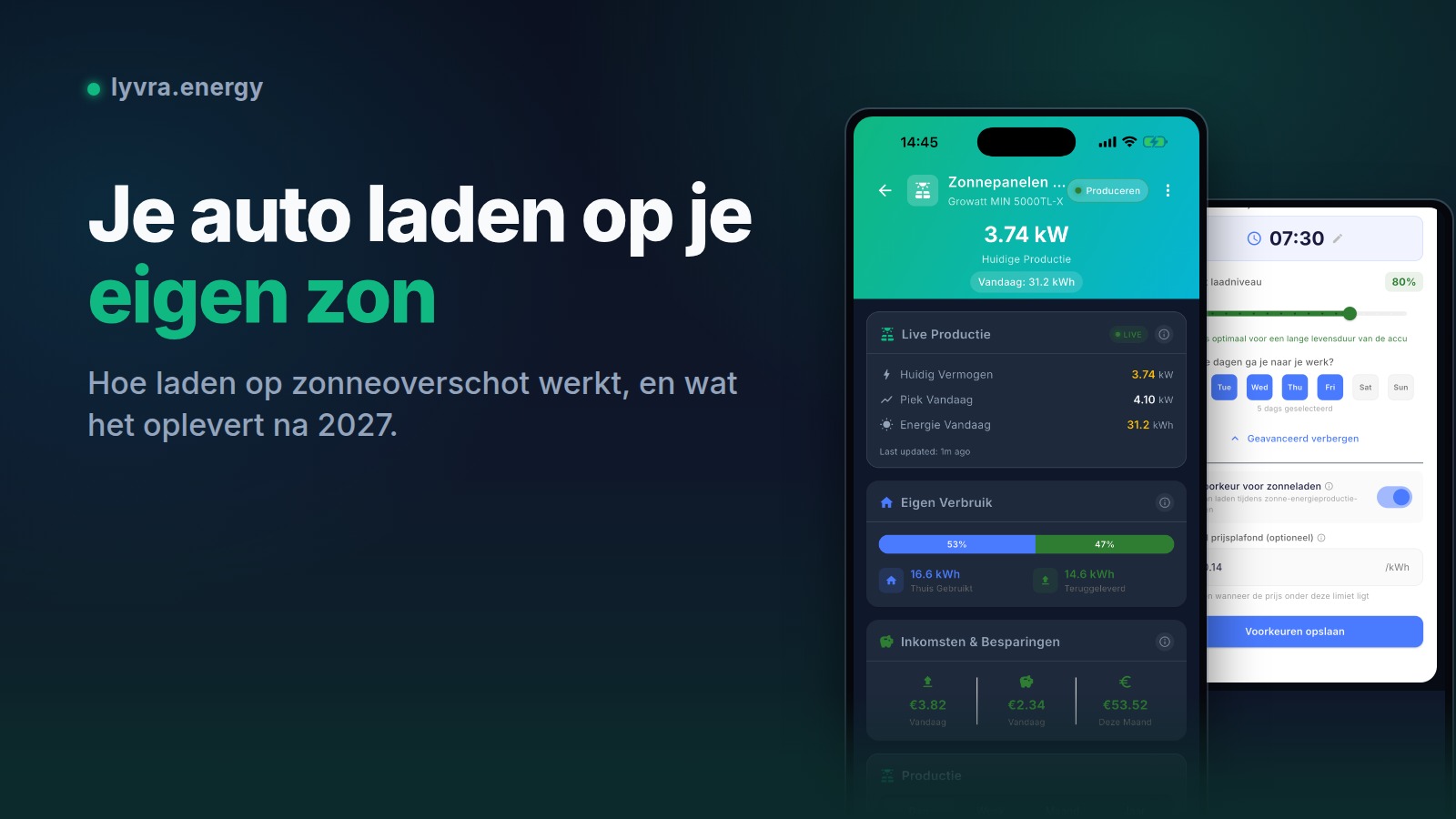
Lyvra pulls the day-ahead EPEX Spot prices each afternoon, combines them with your solar forecast, your current battery state, your EV departure time, and — in Belgium — your current monthly peak, then calculates the optimal charging schedule for the next 24 hours.
You set your preferences once: minimum charge by departure time, whether to prioritise solar, and your cost vs. speed preference. After that, the system handles every charging decision automatically — adjusting in real time if prices or conditions change.
The result: you get the savings of careful manual scheduling without ever looking at a price chart.
Summary
- Dynamic prices vary up to 10x within a single day — timing matters enormously
- Night charging (12am–6am) and solar hours are almost always cheapest
- Evening charging (5–8pm) is almost always the most expensive
- Smart scheduling saves €600–870/year versus unoptimised evening charging
- Combining solar surplus + dynamic pricing can bring annual costs below €0.05/kWh
- Automation removes the need to monitor prices manually
If you're on a dynamic contract and not scheduling your charging, you're paying more than you need to — often significantly more. Lyvra handles the scheduling so you don't have to.