Your solar panels produce far more in the sunnier months
From spring onward, Dutch solar panels come back to life. As the days lengthen and the sun climbs higher, a typical rooftop installation that produces 80–150 kWh per month in December climbs to 300–450 kWh per month, and higher still toward the summer peak.
For most solar owners, this is when a frustrating pattern resumes: the panels generate power during the day while no one is home, that surplus flows back to the grid, and the family charges the car and runs the dishwasher in the evening — buying back expensive electricity they essentially gave away for free a few hours earlier.
This has always been a subtle inefficiency. From 2027, it becomes a costly one.
What Is the Salderingsregeling — and Why Is It Ending?
The salderingsregeling is the Dutch net metering scheme. It allows households with solar panels to offset the electricity they export to the grid against what they import — at a 1:1 ratio at the full retail rate. In practice, it means that a kilowatt-hour exported at noon can cancel out a kilowatt-hour imported at 6pm, as if the grid were a free battery.
It has been an enormously effective policy for driving solar adoption in the Netherlands. The country now has one of the highest residential solar penetration rates in Europe, with over 2.5 million household solar installations.
It is ending for three reasons that are difficult to argue with: the grid was not designed for bidirectional flow at this scale, the cross-subsidy from non-solar households has become politically untenable, and the policy has done its job — solar is now cost-competitive without incentives.
From 2027, exported solar electricity will be compensated at the much lower 'terugleververgoeding' rate — typically €0.03–0.08/kWh — instead of being offset at the full retail rate of €0.25–0.35/kWh.
What This Means in Euros
A typical Dutch household with a 6 kWp solar installation produces around 5,400 kWh per year. Of that, a household that is out during the day might self-consume only 30–40% and export 60–70% back to the grid.
| Scenario | Exported kWh/year | Value per kWh | Annual value of exports |
|---|---|---|---|
| Today (salderingsregeling) | 3,400 kWh | €0.28 (retail offset) | €952/year |
| From 2027 (terugleververgoeding) | 3,400 kWh | €0.05 (feed-in rate) | €170/year |
| Difference | — | — | €782/year less |
That is a drop of nearly €800 per year for a household that changes nothing about how it uses energy. The panels don't produce less — the income from the surplus simply collapses.
The response is straightforward in principle: use more of what you produce, and export less. In practice, this requires either changing behaviour significantly or automating the process.
The Energy Crisis Changed the Baseline
Before 2021, household electricity prices in the Netherlands hovered around €0.22/kWh. The energy crisis that began in late 2021 — driven by surging gas prices, post-pandemic demand, and the impact of the war in Ukraine on European gas supply — pushed retail prices briefly above €0.60/kWh in 2022.
Prices have since moderated but have not returned to pre-crisis levels. The structural floor is higher: more renewable capacity on the grid means more price volatility, and grid infrastructure costs are being redistributed toward heavier users. The era of cheap, predictable electricity is over for the foreseeable future.
This matters for solar owners because it changes the arithmetic of self-consumption dramatically. When grid electricity cost €0.22/kWh, every kWh you avoided buying from the grid saved you €0.22. Today, that same avoided import saves you €0.28–0.35/kWh. The value of your own solar production has increased significantly — and the cost of failing to use it has increased proportionally.
Every kWh of solar power you self-consume instead of export is now worth 5–8 times more than the feed-in rate you would receive for exporting it.
Spring Is When the Mismatch Is Largest
The irony of solar production in the Netherlands is that the months with the highest output are also the months when the mismatch between production and consumption is most pronounced.
In winter, shorter days and lower sun angles mean modest production — and household consumption (heating, lighting, longer evenings) is high. Supply and demand are reasonably well matched.
In spring and summer, the opposite is true. Panels produce at or near their peak during 10am–3pm. Most households are at work. Consumption drops because heating is off and evenings are light. The result: enormous midday surpluses that flow to the grid, while the household still buys power in the morning and evening.
| Month | Typical 6kWp production | Estimated self-consumption (unoptimised) | Surplus exported |
|---|---|---|---|
| December | 180 kWh | 90% (140 kWh) | 40 kWh |
| March | 390 kWh | 45% (175 kWh) | 215 kWh |
| June | 530 kWh | 35% (185 kWh) | 345 kWh |
| September | 400 kWh | 42% (168 kWh) | 232 kWh |
March, April, May, and June are the months where optimising self-consumption has the greatest impact — and where the difference between an unmanaged and a managed home is largest.
How to Maximise Solar Self-Consumption
Shift flexible loads to solar hours
The dishwasher, washing machine, and tumble dryer are all flexible — they don't need to run at a specific time. Running them between 10am and 3pm on sunny days means they run on your own solar power instead of drawing from the grid in the evening. Set them on a timer or run them manually when production is visible.
Charge your EV from solar surplus
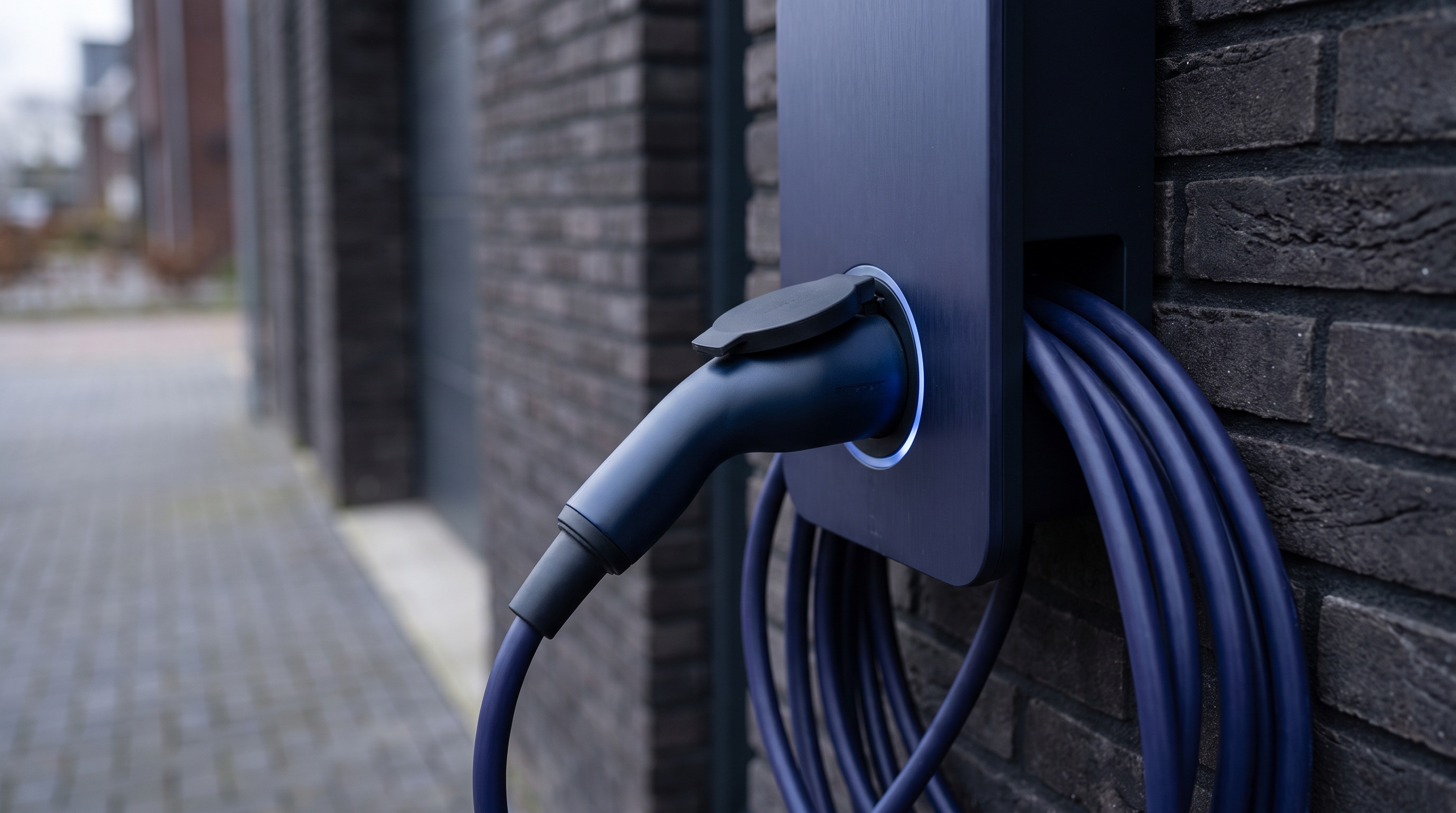
An electric vehicle is the largest flexible load in most households. A typical EV can absorb 6–11 kW when charging — exactly the output range of a 4–8 kWp solar installation at peak production. Configuring your charger to draw only the surplus your panels are producing means that surplus goes directly into your car's battery rather than to the grid at a fraction of its value.
Most modern EV chargers support dynamic power adjustment, which allows a connected energy management system to increase or decrease charging speed in real time as solar production fluctuates with clouds and shadows.
Consider a home battery
A home battery captures midday surplus and makes it available in the evening — effectively turning your solar installation into a 24-hour supply. With the salderingsregeling ending, the economics of home storage improve significantly: the battery earns the difference between the feed-in rate (€0.05/kWh) and the retail rate (€0.30/kWh) every time it stores and then supplies solar power.
Battery payback periods have shortened considerably as hardware costs have fallen. For households with large solar installations and high evening consumption — particularly EV owners — a battery is increasingly worth modelling seriously.
Automate the whole thing
The challenge with manual optimisation is that solar production is weather-dependent and unpredictable. A schedule that works on a sunny day wastes grid electricity on a cloudy one. An energy management system that reads real-time production data, weather forecasts, and energy prices can make the right decision continuously — adjusting EV charging speed, shifting controllable loads, and managing battery state automatically.
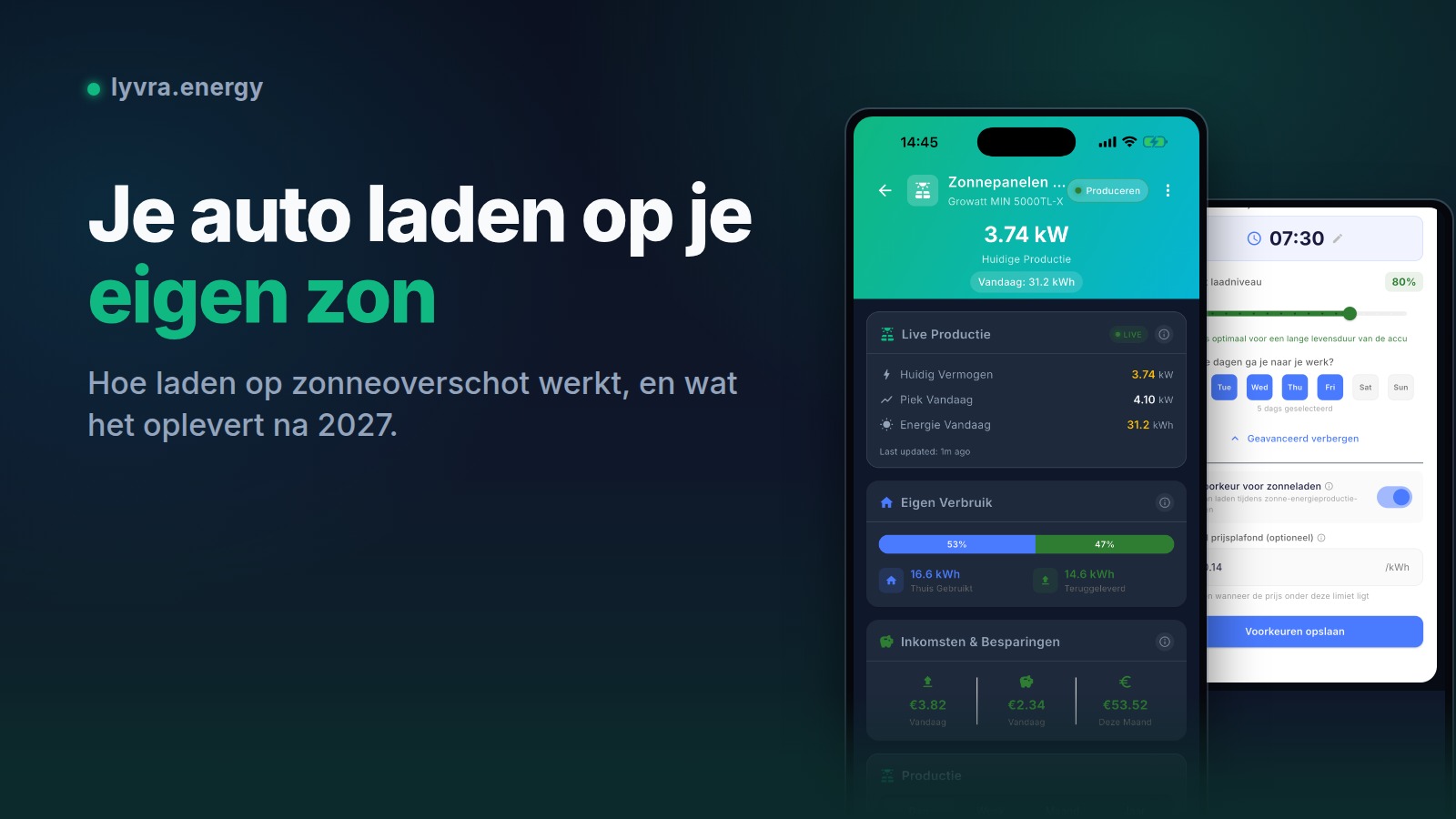
Lyvra connects to your smart meter, EV charger, solar inverter, and home battery — and continuously optimises the flow between them based on live production data, weather forecasts, and energy prices. No manual intervention required.
The Window Before 2027
The salderingsregeling phase-out leaves Dutch solar households only a matter of months to adapt before the economics change permanently on 1 January 2027. The households that build or automate high self-consumption now will enter 2027 with systems already optimised. Those who wait will face the full impact of the rate change without mitigation.
The good news is that the tools exist today. Smart meters, connected EV chargers, solar inverter APIs, and energy management platforms have matured to the point where full automation is genuinely accessible — not just for technically minded early adopters, but for any homeowner willing to set it up once.
Summary: What to Do Before Net Metering Ends
- Understand your current self-consumption ratio — most households with solar export more than they realise
- Shift flexible loads (dishwasher, laundry) to solar production hours during spring and summer
- Configure your EV charger to draw solar surplus when the car is connected during the day
- Model whether a home battery makes sense given your production, consumption, and the upcoming rate change
- Automate the optimisation so it runs continuously without manual adjustment
Your solar installation is at its most productive through spring and summer — and with the salderingsregeling ending on 1 January 2027, the window to prepare is closing fast. That combination of high production and an approaching deadline makes now the right moment to act.